
13 Classroom Setup Ideas That Build Critical Thinking Skills All Year Long

Every wall, display, and organizational system in the classroom has a purpose: helping students become independent thinkers, problem-solvers, and creators.
Your classroom walls can do more than display student work. They can become tools that inspire curiosity, encourage deeper thinking, and support meaningful learning throughout the year. That’s why it is so important to put a lot of thought into this when setting up your classroom at the beginning of the school year. Consider how your environment can help students develop the skills they need to analyze, create, communicate, and solve problems.

For GATE (Gifted & Talented) and enrichment classrooms especially, a thoughtfully designed space can serve as a daily reminder that students are capable of complex thinking. Here are 13 classroom setup ideas that will help transform your classroom into a space where critical thinking is visible, valued, and practiced every day.
Depth & Complexity icons provide students with visual thinking tools that encourage them to look beyond the surface of a topic. Displaying these icons as large posters helps students recognize different ways to approach learning, ask deeper questions, and make meaningful connections across subjects. I like to put magnets on the back after they are laminated so that they can attach to a white board and move around easilly.

Create a dedicated space for an Interactive Thinking Frame that guides students to think about the content through the lens of a specific disciplinarian (mathematician, biomimicry engineer, author, innovator, etc.). For even more student buy-in and excitement, make it JUMBO-sized and on a whiteboard so that they can add to it throughout the unit!

These frames help students organize their ideas while practicing skills like analyzing details, identifying patterns, exploring multiple perspectives, and making connections. Select four Depth & Complexity prompt icons to put in the four quadrants of the frame.
Find a space to display a Prompt of the Week that encourages students to practice one Depth & Complexity icon throughout the week. Each week, select one prompt icon to highlight and display it in a special frame or designated area where students can easily see and reference it during learning.

Make the icon part of your classroom language by intentionally referring to it during lessons, discussions, and activities. Challenge students to use the prompt when analyzing content, asking questions, and explaining their thinking. To reinforce understanding, pair the weekly icon with corresponding Prompt of the Week worksheets or activities that allow students to practice applying the thinking tool across different subjects.

Scholarly Habits remind students that strong thinkers develop habits like perseverance, curiosity, risk-taking, and excellence. Display these traits as classroom expectations to encourage students to approach challenges and learning just like a scholar would.
Create a dedicated space for student enrichment binders. An organized enrichment area encourages independence and allows students to easily access resources, track their learning, and revisit previous thinking. Each student should have their own designated binder, and you can prepare these weekly with ready-to-go lessons and activities. To find out more about what I put in these Enrichment Binders, check out this BLOG POST.
STEM & Innovation Station
Create a space with materials, challenges, and resources that encourage students to design, build, create, and explore. This is especially valuable for STEM and project-based learning activities. I like to create bins with different materials for quick access. You can also provide Quick STEM Challenges for early finishers or small blocks of time.
Display the steps of the Engineering Design Process as a visual guide to support students during STEM challenges, problem-based learning, and design projects. These posters help students understand that innovation is a process that involves asking questions, imagining solutions, creating prototypes, testing ideas, and improving designs through reflection and revision.

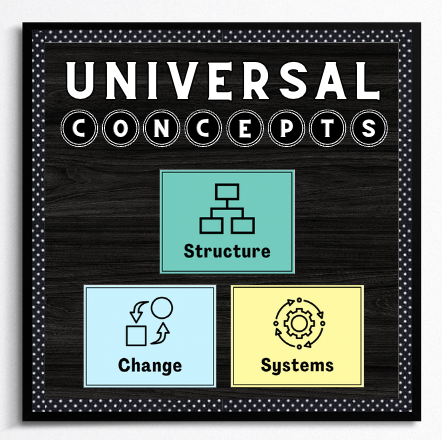
Universal Concepts help students connect classroom learning to bigger ideas that extend beyond a single lesson or unit. Displaying these concepts encourages students to recognize themes, make connections between subjects, and think about the world in broader ways.
4 Cs of 21st Century Skills Display
Create a visual reminder of the skills students are developing every day: Critical Thinking, Communication, Collaboration, and Creativity. These skills can become a common language in your classroom as students work together, share ideas, and solve authentic problems. Over time, you will start to see your students referring to these on their own! The best is when students start pointing to the bold words on the wall as they are practicing them in real-time in the classroom! You can find these large letters at craft stores like Michael's and Hobby Lobby.

Student Thinking Frame Wall
Create a rotating display where students showcase their own thinking frames throughout the year. These are smaller, paper, student-created versions of the jumbo Interactive Thinking Frame that is on the whiteboard. Feature monthly or thematic thinking frames, and keep all of the previous ones behind it. At the end of the year I bind them all together and make a booklet for them to celebrate all of their amazing thinking throughout the year.
Focus Wall
A focus wall helps students see what they are learning and why it matters. Include essential questions, learning goals, vocabulary, standards, and thinking tools so students can easily connect daily activities to the bigger picture.

Depth & Complexity Student Name Plates
Use student name plates as an opportunity to make thinking tools part of students’ everyday learning environment. Adding Depth & Complexity icons or prompts to student spaces reinforces that these strategies belong in all areas of the classroom.

Thinking Stems Display
Provide students with sentence starters that support discussion, reflection, and deeper conversations. Thinking stems help students explain their reasoning and communicate their ideas more effectively. These are perfect for Socratic Seminars!
Final Thoughts:
A classroom designed for critical thinking goes beyond colorful decorations. It creates an environment where students are encouraged to explore and think deeply. By intentionally setting up spaces that support higher-level thinking, you can create a classroom culture where students see themselves as problem-solvers, innovators, and lifelong learners.
Remember, your classroom walls can teach too. When students walk into a space that celebrates thinking, curiosity, and creativity, they are reminded every day that their ideas matter.
Most of the resources mentioned in this blog post can be found on TPT here, or in the Lodge's Learning Library here!


Comments